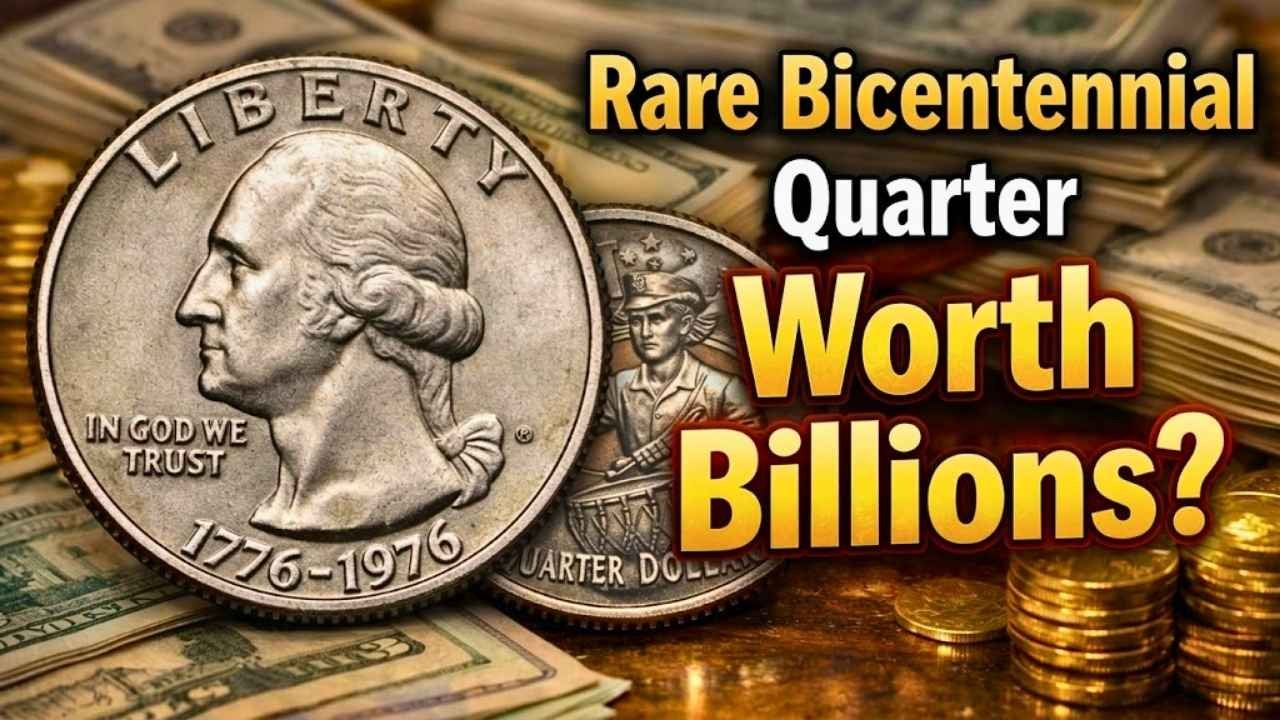
The Bicentennial Quarter, minted in 1975 and 1976 to celebrate America’s 200th anniversary, is one of the most recognizable coins in U.S. history. Featuring a colonial drummer on the reverse and the dual date 1776–1976, it became a symbol of patriotism during the bicentennial celebrations. Recently, rumors have circulated online claiming that a rare Bicentennial Quarter is worth an astonishing $2.5 billion. But is this claim fact or fiction? In 2026, collectors and enthusiasts continue to debate the truth behind this story.
The History of the Bicentennial Quarter
The Bicentennial Quarter was part of a special coinage program that included the half dollar and dollar. The reverse design, created by Jack L. Ahr, depicts a colonial drummer with a torch surrounded by thirteen stars. These coins were struck in both copper-nickel for circulation and 40 percent silver for collector sets. With millions produced, they were widely distributed and remain common today.
The $2.5 Billion Claim
The story of a Bicentennial Quarter worth $2.5 billion has spread across social media and coin forums. While it captures attention, the claim is not supported by numismatic evidence. No coin in history has ever sold for such a staggering amount. The most valuable coins, such as the 1933 Double Eagle or the 1804 Silver Dollar, have sold for tens of millions, but never billions. The rumor likely stems from exaggerated online posts or misunderstandings about coin values.
Real Value of Bicentennial Quarters
Most Bicentennial Quarters are worth only face value in circulated condition. Uncirculated and proof examples, especially those struck in silver, can be worth a few dollars to collectors. High-grade coins certified by professional grading services may command higher premiums. Rare error varieties, such as doubled dies or off-center strikes, can be worth hundreds or even thousands depending on rarity and condition. However, none approach the billion-dollar mark.
Error Varieties
Error coins are among the most exciting finds for collectors. Bicentennial Quarters have produced several notable errors, including doubled dies, off-center strikes, and coins struck on wrong planchets. These mistakes are rare and can command significant premiums. For example, a Bicentennial Quarter struck on a dime planchet is a highly prized error that has sold for hundreds or more at auction.
Collecting Tips
For those interested in Bicentennial Quarters, condition is key. Coins should be stored properly to prevent tarnish or damage. Proof and silver issues are best preserved in their original packaging. Beginners may start by collecting circulation strikes, while advanced collectors often seek out rare varieties and error coins. Building a complete set of Bicentennial coins, including the half dollar and dollar, can be a rewarding project.

Investment Potential
While most Bicentennial Quarters are not highly valuable, rare varieties and error coins have shown steady growth in value. As demand continues to rise, prices for high-grade examples and silver issues remain strong. Collectors who focus on quality and rarity often see the best returns. The Bicentennial Quarter, with its historical significance and unique design, continues to hold investment potential in 2026.
Key Highlights
- The Bicentennial Quarter was minted in 1975 and 1976 to celebrate America’s 200th anniversary.
- The claim of a $2.5 billion Bicentennial Quarter is fiction, not supported by numismatic evidence.
- Common circulation strikes are worth face value, while silver-clad and proof coins hold added value.
- Rare errors such as doubled dies and off-center strikes can be worth hundreds or thousands.
- Collectors in 2026 continue to seek out rare varieties and hidden treasures.
Final Words
The story of a Bicentennial Quarter worth $2.5 billion may be entertaining, but it is not grounded in reality. While these coins are historically significant and can hold value in certain conditions, they are not billion-dollar treasures. In 2026, collectors continue to appreciate Bicentennial Quarters for their design, history, and occasional rare varieties. Whether you are a seasoned numismatist or a beginner, exploring these coins offers both enjoyment and the potential for discovery. With patience and knowledge, you may uncover a coin that is worth far more than you ever imagined—just not billions.